LOS vs RF (FSPL & ITM)
Waveshed answers two different questions. LOS is about visibility. RF is about signal. Picking the right one matters.
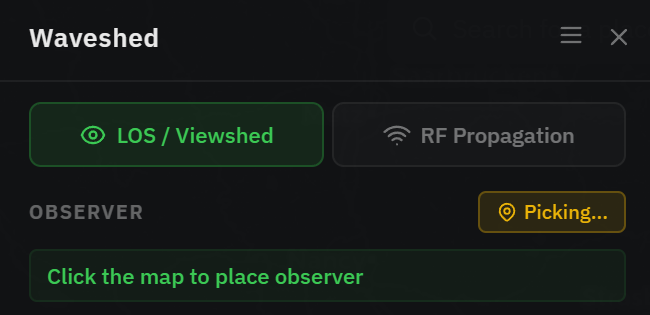
LOS / Viewshed
Pure geometry. From your observer, is there an unobstructed sight line to each point, given the terrain and the curve of the earth? That is a viewshed, “what can I see from here”. It is fast and frequency-independent. Ideal for vantage points, optical/laser links, or a quick feel for whether two spots can “see” each other.
RF propagation
RF estimates path loss to predict received signal strength. Two models:
- FSPL (Free Space Path Loss), the simplest case: distance and frequency only, no terrain. A quick best-case figure. (Coming soon in Waveshed.)
- ITM / Longley-Rice, the irregular-terrain model that accounts for terrain diffraction. It is the industry standard for real coverage and the model Waveshed uses today. It needs a frequency and a transmit power.
ITM is published by the NTIA’s Institute for Telecommunication Sciences (ITS), which has maintained this reference propagation model since 1968.
LOS vs RF at a glance
| LOS / Viewshed | RF (ITM) | |
|---|---|---|
| Question answered | What can I see from here? | Where does my signal reach? |
| Output | Binary visibility (yes / no) | Graded signal level (dBm) |
| Needs frequency & power? | No | Yes |
| Best for | Vantage points, optical & laser links | Radio coverage & link planning |
Earth curvature
LOS uses the true optical horizon. Radio bends slightly with the atmosphere, so RF uses the conventional 4/3 effective-earth radius, whose horizon reaches a little further than the optical one. You can see both rays side by side in the elevation-profile tool.
The diffraction that carries radio past the bare sight line is set out in ITU-R Recommendation P.526.
Frequently asked questions
What’s the difference between LOS and RF?
LOS (line of sight) is pure geometry. It shows what is visible from your observer, a yes/no viewshed that ignores frequency. RF estimates path loss with ITM / Longley-Rice and returns a graded signal level in dBm, accounting for terrain diffraction. One answers visibility, the other answers coverage.
Which one should I use?
Use LOS for visibility questions: vantage points, optical or laser links, and quick “can these two spots see each other” checks. Use RF / ITM for radio coverage and link planning, where frequency and transmit power matter. If a frequency is part of your question, you want RF.
Does frequency change coverage?
For RF, yes. RF needs a frequency, while LOS is frequency-independent and never uses one. Frequency feeds the path-loss calculation, so it directly shapes the predicted signal and how far usable coverage extends. A viewshed, by contrast, looks the same at any band.
Why does RF show coverage where there’s no line of sight?
Because radio is not limited to a straight optical ray. ITM / Longley-Rice models diffraction, where signals bend over and around terrain, so RF predicts usable coverage in spots a strict line-of-sight viewshed marks as hidden. RF also uses the 4/3 effective-earth horizon, which reaches a little further than the optical one.