Eight megawatts over the Alps to Zürich
In November 1979 Roger Schawinski set out to break Switzerland’s public-broadcasting monopoly. He put a radio station on an Italian mountaintop and aimed it at Zürich, about 130 km away. Radio 24 became a national obsession. For anyone who plans coverage it is also a near-perfect lesson in site, power and directionality.
A 2,900-metre loophole
The transmitter sat near the summit of Pizzo Groppera, roughly 2,950 m up and just inside Italy, a stone’s throw from the Swiss border above the Mesolcina valley. The site did two jobs at once. Legally it stood on Italian soil, out of reach of Swiss regulators. Physically, nearly 3,000 m of height bought enormous range. It did not buy a clear view of Zürich. The Alpine ridges between the peak and the city block any optical line of sight, so the signal had to get there another way.
50 kW into a wall of 32 fields
Two 25 kW Collins FM transmitters fed the antenna, about 50 kW in total. The antenna was the real trick. It was a wall of 32 stacked directional fields with roughly 22.5 dBd of gain, broadcasting around 101.6 MHz. Do the arithmetic and 50 kW lifted by 22.5 dB lands near 8 megawatts of effective radiated power in the beam. In a 1980 documentary Swiss television called it the world’s strongest civilian FM directional transmitter.
That headline 8 MW figure was argued over endlessly at the time, and the exact number matters less than the mechanism. The transmitter never produced megawatts. The antenna did, by refusing to waste power in any direction but one.
Why point it like a searchlight?
A directional antenna does two useful things here. It concentrates almost all the radiated energy into a narrow arc toward Zürich, so nothing is squandered on empty valleys. That is how a modest 50 kW becomes megawatts on boresight. It also keeps the beam off neighbouring countries’ frequencies. Waveshed lets you model this either way. Enter the 50 kW transmitter power and the antenna gain and it works out the radiated power for you, or enter the ERP directly if you already know it. Radio 24’s transmitter made 50 kW. The antenna made the megawatts, in a single direction.
Reaching the city
130 km is a long way for FM, which normally lives and dies by line of sight, and here there was none. The Alps sit squarely between the peak and the city. Radio 24 still won, on three factors at once. A very high site, an enormous beam ERP pointed straight at the audience, and a receiver population in the open lowland basin. The signal reached the city by diffracting over the intervening ridges rather than along any clear path, which is exactly the kind of beyond-line-of-sight propagation the ITM model is built to predict. A plain line-of-sight tool would show Zürich dark. ITM does not. Ordinary car radios and kitchen sets picked it up cleanly.
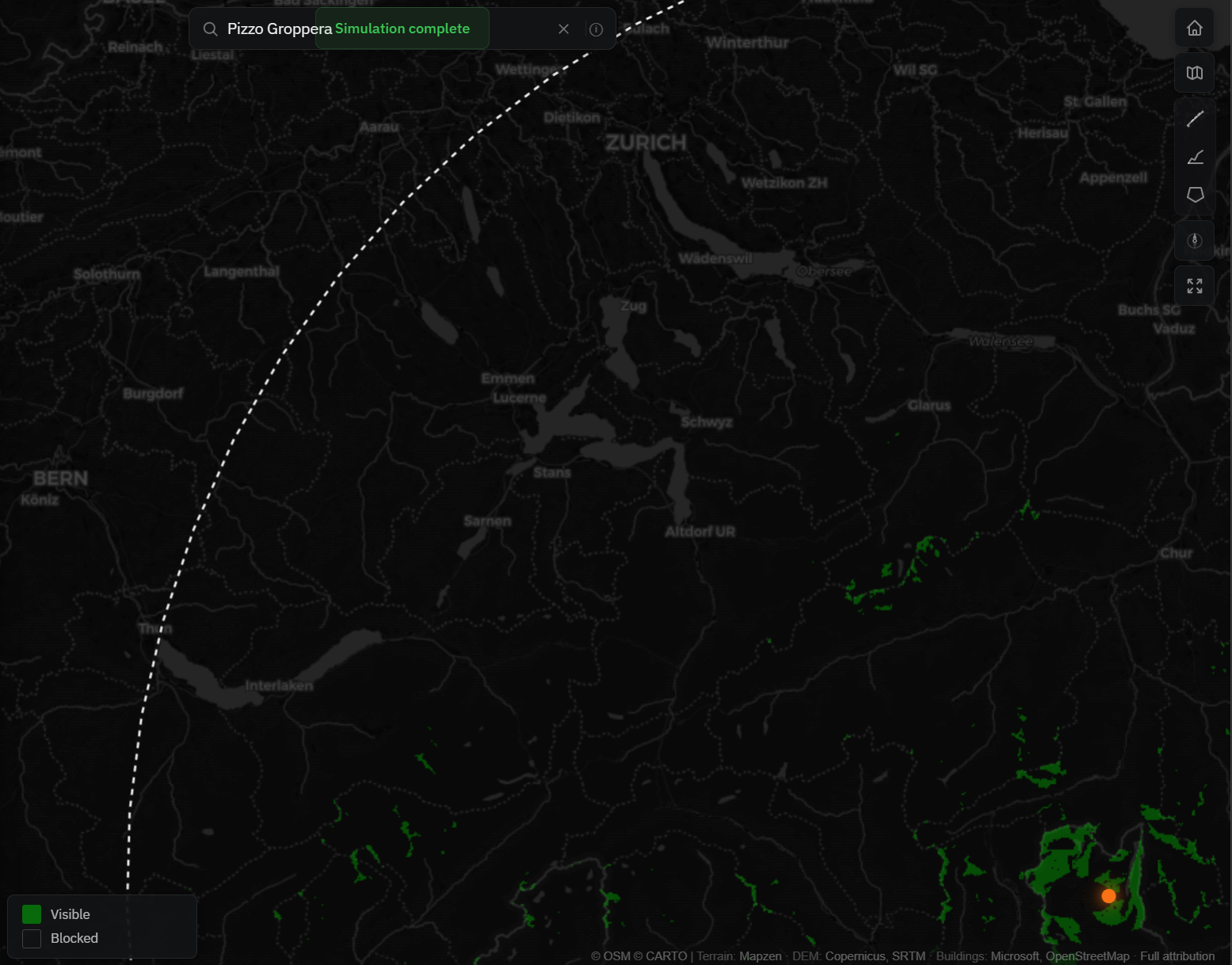
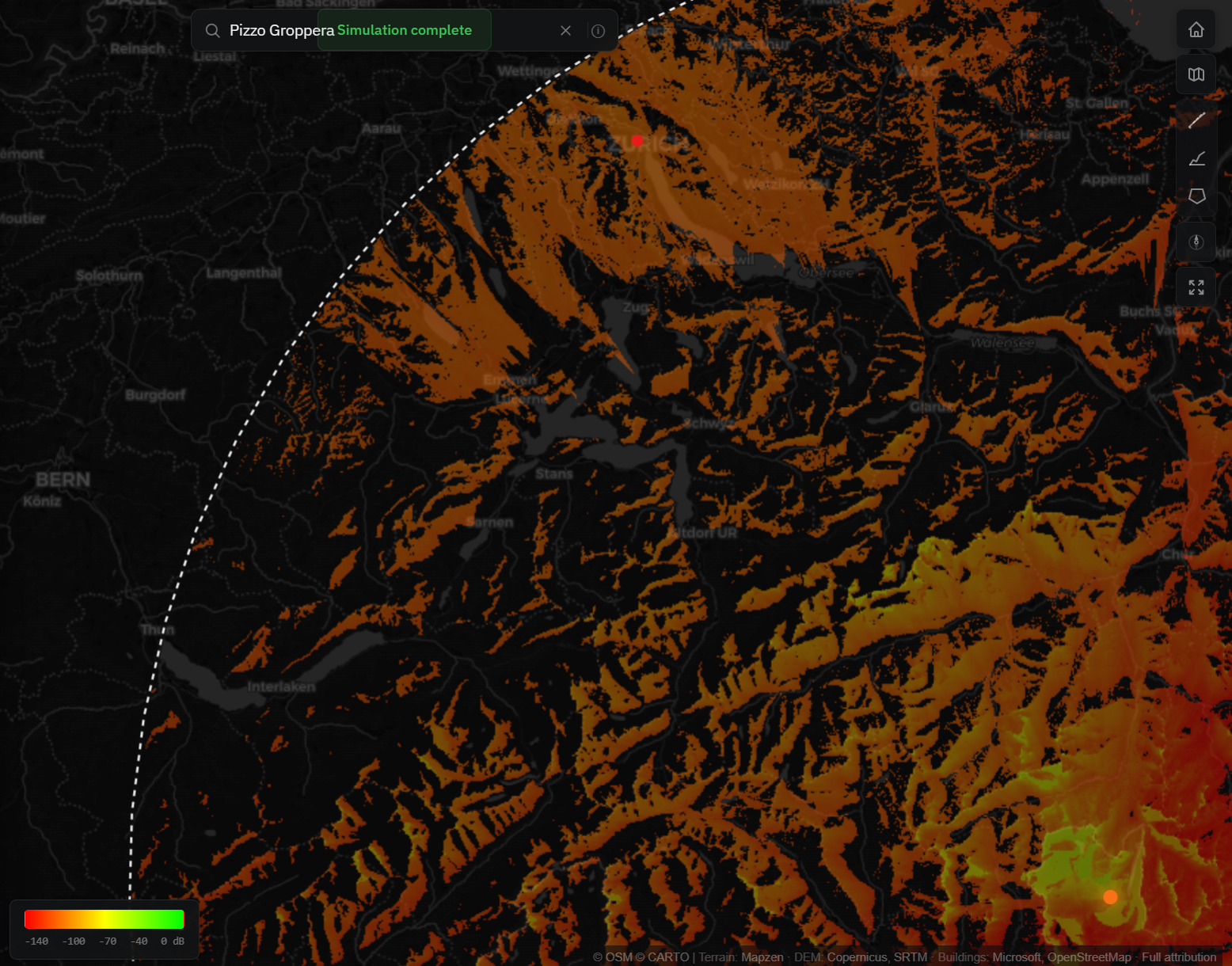
Diffraction over the ridges does the rest. See radio propagation for the physics.
Cat and mouse, then a licence
Italian authorities, leaned on by Bern, shut the site down more than once, and it kept coming back on air. The pirate broadcast, helped by a petition with hundreds of thousands of signatures, pushed Switzerland to finally license private radio. In 1983 Radio 24 came home, moving its transmitter to Zürich’s own Üetliberg and trading an 8 MW beam from abroad for a legal local signal.
Model it in Waveshed
You can recreate the essentials. Drop a transmitter on Pizzo Groppera at about 2,900 m AMSL and set roughly 100 MHz. For power, switch to TX + Gain and enter 50 kW with about 24.6 dBi, then open the Sensor / Antenna panel and build a narrow directional pattern aimed at Zürich (a bearing near 320°). Run ITM and watch the beam stretch north-west over the foothills. Because a near-3,000 m site height does so much of the work, the result is a lopsided coverage lobe that reaches far further in one direction than a transmitter ten times as powerful would manage from the valley floor. The same ingredients Schawinski used, minus the police.
For the antenna pattern, set the azimuth to Directional with a bearing near 320°, a beamwidth around 40°, a front/back around 25 dB and a sidelobe floor near −25 dB. Set the elevation to Directional too, with a narrow beam near 6°, the same −25 dB floor and 1–2° of down-tilt. The array gain is 22.5 dBd, and Waveshed enters gain in dBi, so use about 24.6 dBi with the 50 kW to land on the 8 MW ERP. To shade where the signal stays usable, set Min signal to about −100 dBm, roughly where an FM car radio still locks on.
Figures are drawn from contemporary Swiss reporting and the German-language Wikipedia article on Radio 24. Wikipedia rejects the sweeping claim that it was the world’s strongest FM transmitter. It was the strongest civilian directional one, the 8 MW being ERP concentrated in the beam toward Zürich rather than raw transmitter power.